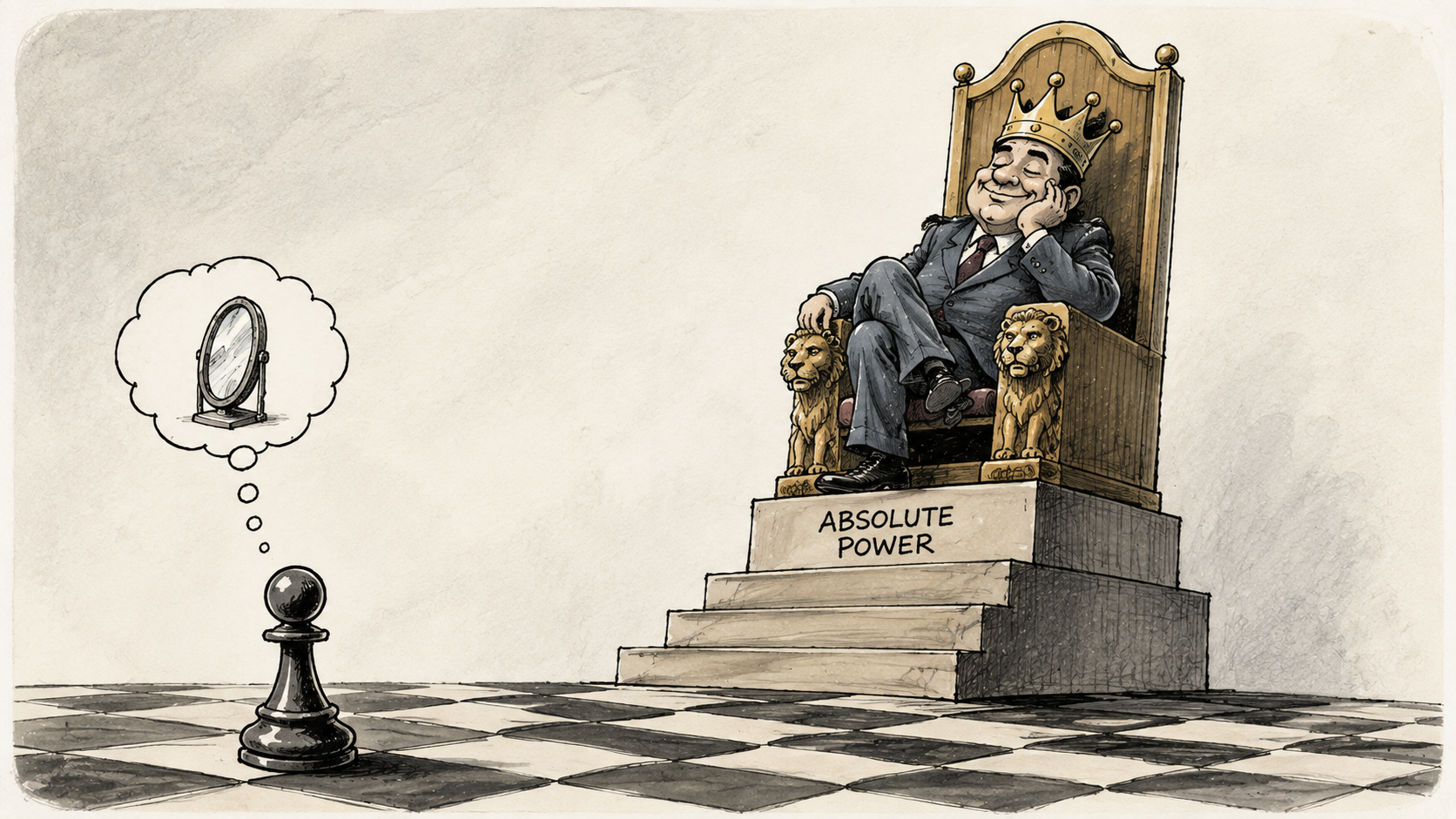
In 1887, the historian John Dalberg Acton, First Baron Acton, wrote to Bishop Mandell Creighton to object to something the Bishop had done, judged popes and kings by gentler standards than he would apply to ordinary men. Out of that argument came the line that has long since outgrown its original context: power tends to corrupt, and absolute power corrupts absolutely.
The aphorism, when split into two, provides claims of different strength. The first is the general case where authority of almost any kind, even the modest, the accountable, and temporary kind, nudges its holder toward self-interest and away from restraint. The latter is the extreme case, where power and those holding it are answerable to no one. History offers us the starkest evidence for the latter, taking the Romans for example, whereas the long history of revolutions that promised liberty and produced new tyrannies offers abundant evidence for the first.
I. Absolute Power Corrupts Absolutely: The Roman Emperors
Rome was never an autocracy by declaration; but became one by erosion. Augustus (Gaius Octavius), the first emperor, was careful never to call himself king or even emperor in any formal sense, rather he styled himself princeps, "first citizen," preserving the outward machinery of the Republic, meaning the Senate still met, magistrates still stood for election, the old titles still meant something on paper. However, Augustus held permanent command of the army, permanent control over the treasury, and permanent authority over legislation, and every institution that was to keep him in check depended on his goodwill for its continued existence. The forms of shared government existed; however, its substance was lost.
Once the power to remove, outvote, or overrule the ruler is out of the question, the character of that ruler stops being a variable subject to correction and becomes the only thing standing between the state and disaster. Rome would spend the next four centuries discovering how bad a bet that is. In a span of three generations, the empire had Caligula, who demanded to be worshipped as a living god and was murdered by his own guard less than four years into his reign; Nero, who had his own mother killed and eventually took his own life after being declared a public enemy and abandoned by his guard; and Domitian, who insisted on being addressed as dominus et deus, "lord and god," and was assassinated in a palace conspiracy that included his own wife.
These three are a small example of many men not flawed rather placed in the same structural position, and that position produced a recognizable pattern: isolation from honest counsel, since flattery is the safer option when the ruler's mood decides who lives; the erosion of any distinction between the ruler's appetites and the state's business, since no one can tell him no without it meaning certain death; and a slide toward self-deification, since it is a logical outcome of such treatment. That is what Acton meant by absolutely: not that every emperor was equally cruel, but that the position itself, stripped of any external check, tends toward the total corruption of whoever occupies it.
II. Power Corrupts: Revolutions Against Power That Become Power
The milder half of the claim requires a lesser degree of extreme conditions to manifest itself, and the pages of history have no shortage of cases in which power gained through anti-authoritarian, egalitarian movements was nonetheless corrupted along a recognizably similar path, not because revolutionaries are bad people, but because the same structural flaws that were the undoing of Caligula or Domitian reassert themselves in any position unaccountable to a check.
The French Revolution, what began in 1789 as a rebellion against precisely the kind of unaccountable royal power Rome had once institutionalized, and its early language, liberty, equality, fraternity, was a direct repudiation of absolutism. In just four years, the revolutionary government had produced its own machinery of arbitrary killing, now known as The Reign of Terror. And a decade later, Napoleon Bonaparte crowned himself Emperor of the French. (The very title the revolution had begun by abolishing.)
The Russian Revolution of 1917 followed a comparable arc though on a larger scale. The Bolsheviks overthrew the Tsarist autocracy in the name of the industrial worker and the peasant, and within a generation, Joseph Stalin had built one of the most concentrated and unaccountable individual powers of the twentieth century.
The clearest illustration, however, and the one most instructive for what "power corrupts" means when the power in question is not a monarchy at all, is the Chinese Communist Party. Mao Zedong's government, established in 1949, went on to engineer the Great Leap Forward, a set of agricultural and industrial policies so disconnected from honest feedback that tens of millions starved to death while local officials, fearing to report failure to an unaccountable center, falsified harvest figures instead. The Cultural Revolution that followed turned the party's own machinery against much of Chinese society, including against its own ranks, for a decade. And in the current era, under Xi Jinping, presidential term limits were formally abolished in 2018.
None of this depends on what a power calls itself, or what it originally opposed; once any authority, royal, revolutionary, or bureaucratic, is freed from the mechanisms that let it be corrected, criticized, or removed, it tends to drift toward the same brutal endpoint, regardless of the ideals it started with.
III. Plato's Answer: The Philosopher King and the Five Good Emperors
When left unchecked, power reliably corrupts; the question Plato set himself in the Republic was whether there was any kind of person whose character might resist that pull. His answer was the philosopher-king. Such a person, Plato argued, would rule as a kind of unwelcome duty rather than a prize, precisely because ruling well requires attention diverted from the philosophical life such a person would otherwise prefer. A ruler who would perform his duty and not be intoxicated by the power would rather maintain temperance in utilizing it.
The proposal is famously difficult to institutionalize; Plato himself struggled to describe how a society could reliably produce or identify such a person, but history has answers to every question and approximately 500 years after Plato, Roman history furnishes the one sustained period that comes closest to testing it in practice: the age of the Five Good Emperors.
Between 96 and 180 CE, Rome was governed in succession by five emperors: Nerva, Trajan, Hadrian, Antoninus Pius, and Marcus Aurelius, often called the Five Good Emperors or Nerva–Antonine dynasty.
What set this period apart structurally was succession by adoption rather than blood: each of the first four emperors, lacking a suitable biological heir or choosing to set one aside, adopted a capable and experienced successor rather than passing power automatically to a son. The result, whether by careful design or fortunate accident, was nearly a century in which the empire was ruled by men selected solely for competence and temperament rather than birth, and the historian Edward Gibbon would later judge this era, in a frequently cited assessment, to be among the most well-governed and prosperous stretches in the whole of human history. It is a striking natural experiment: remove hereditary succession, the mechanism that guarantees nothing about the character of the next ruler, and substitute something closer to selection on merit, and the corrosive pattern seen under Caligula, Nero, and Domitian largely disappears for four consecutive reigns.
Marcus Aurelius Antoninus, the last of the five, is the figure who comes closest to Plato's ideal in substance and not merely in position. He was a practicing Stoic philosopher before he was ever emperor, and the private notebook he kept during his reign, known to us as the Meditations, was never intended for publication; it is a record of a man holding absolute power over the known world while constantly reminding himself, in private, to be patient with fools, indifferent to flattery, and constantly reminding himself of his own mortality.
He governed through a war on the Danube frontier and through the Antonine Plague, one of the worst epidemics in Roman history, without the theatrical cruelty or self-deification that marked so many of his predecessors and successors. He is, as close as Roman history offers, a philosopher-king who actually held the throne, proof that Acton's "absolutely" was not, in fact, an iron law of physics, but a tendency that a sufficiently disciplined character could resist.
Conclusion
Taken together, the Roman emperors and the long history of revolutions gone sour supply overwhelming support for both halves of the claim: power in general tends to erode the restraint of those who hold it, and power held without any check tends to erode it almost completely. None of this means the world should wait and hope for more philosopher-kings; history suggests they are far too rare and far too fragile a solution to rely on. It is that the corruption of power is best resisted not by the character of whoever happens to hold it, but by structures, the rule of law, genuine limits on tenure, institutions capable of saying no, that do not depend on any one person's goodness to keep functioning. Institutions matter because virtue cannot be inherited.
About the Author: Ishan is a graduate of the law, tempered further by an enduring devotion to history and to the philosophies of old, pursuits from which he draws whatever discipline and clarity his present work requires.
Join the Conversation