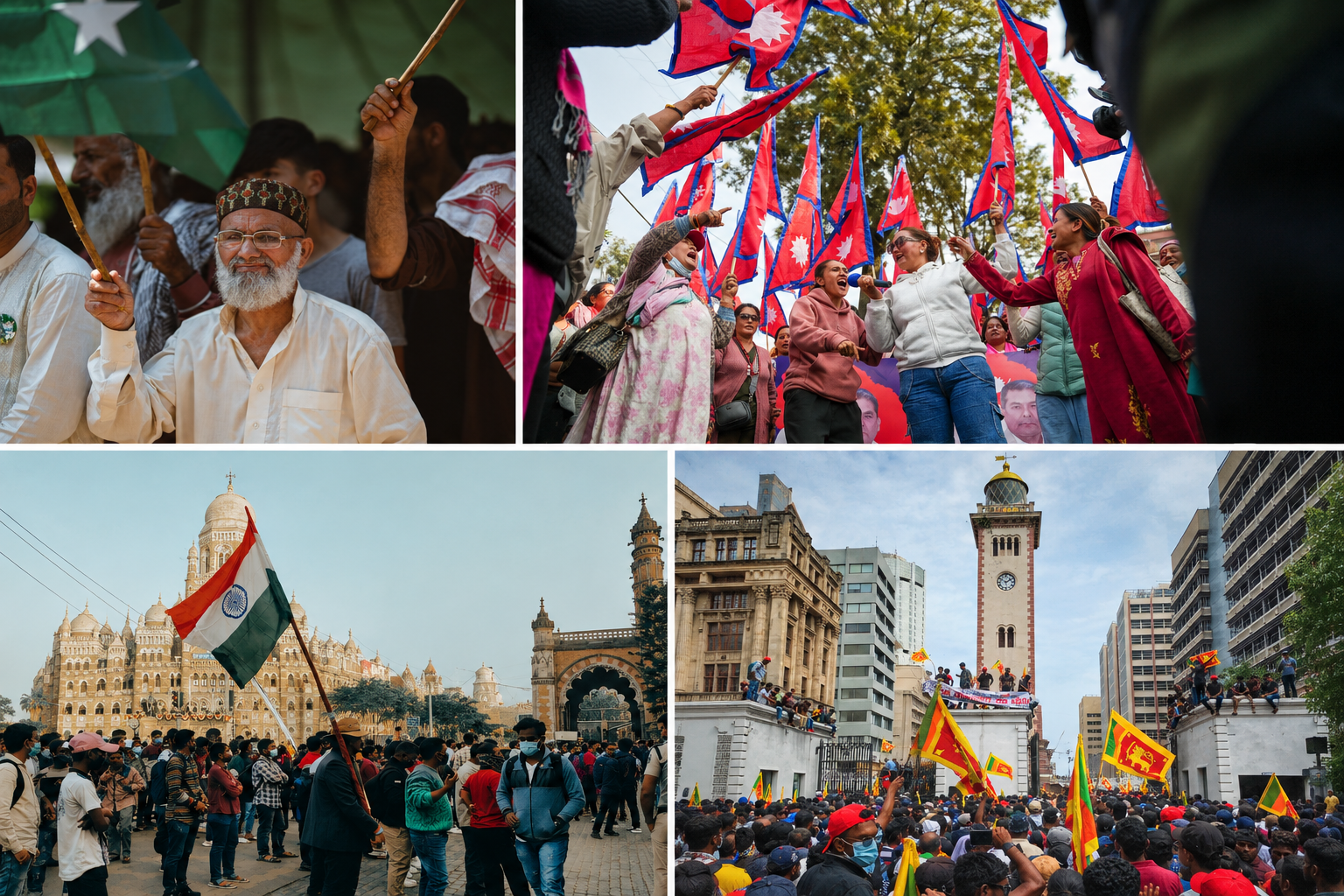
Sri Lanka sneezed back in 2022, and South Asia continues to catch the cold today. The region has witnessed one of their largest public mobilisation movements post-independence. While prima facie, the protests appear to be unique, with different factors, leaders and governments, consequences and recoveries, there appears to be a few common factors that directed their destinies to many common outcomes, with deep consequences for the future of the region as a whole in terms of democratic polity and national security. Below are a few accounts on the uprisings and protests against the respective South Asian Governments.
Sri Lanka (2022)
The cause was an economic crisis triggered by policies adopted by the Gotabaya Rajapaksha regime. Acute shortage of food, fuel and cooking gas was widespread and hospitals had run out of electricity and medicines. Examinations were cancelled, leading to disrupted futures of countless young. Forex, remittances, tourism took a hit. Government’s response included blanket ban on import of fertilisers, which was deemed unnecessary and damaging to the economy. Russia-Ukraine crisis further worsened the situation. Market irregularities resulted as the government decided to give out rations of vegetables and food articles. Ultimately, the public reached a tipping point, and declared “Araglaya”, meaning struggle. In march 2022, the protesters rampaged the streets of Colombo, ultimately ousting the president from power, and reclaimed their rights from the government. By April 2022, nearly the entire Sri Lankan cabinet resigned. By May, the protests became violent, leading to 9 deaths and 300 injured (investing.com)
Pakistan (2022)
Pakistan’s experience was different from that of Sri Lanka – The protests in Sri Lanka were anti-government, while the protests in Pakistan were not so inherently, but rather Pro-Imran Khan. The concerns were military domination, electoral legitimacy and democracy. Imran Khan was removed by a vote of no-confidence, becoming the first majority leader to be removed by the convention. He alleged irregularity and military involvement in the elections. The PTI led by Imran Khan led a popular uprising in April 2022 and called for saving the democracy in Pakistan. He was arrested in 2023, following nationwide protests. This protest was brutally suppressed with confirmed 8 deaths, and a bizarre 2000 arrests.
Bangladesh (2024)
The cause in Bangladesh was much more complicated than before, and it introduced an element that came to define the region here on – Engagement of the Gen-Z. The protests in Bangladesh were largely youth led, as they were the largest affected party. The concerns were many, including erosion of democracy by the Sheikh Hasina regime, and a core issue of quota reserved for freedom fighter’s descendants. Naturally, it did not sit well with the majority of the students. The uprising resulted in a violent mass movement, leading to an estimated death toll of 1400 people (UN investigation) and 10,000 arrests. The military showed conscience, and decided to not follow the orders of Sheikh Hasina, leading to her exile, and ultimately fall of her government. What followed was unfortunate for the Bangladesh democracy, as socially ill elements took charge of the protests, and many Hindus were persecuted.
Nepal (2025)
The protests in Nepal were a fascinating upsurge among all the protests. It exposed the government’s corrupt and brutal face. It was triggered by a social media trend started by the youth frustrated by the nepotism in the system as it existed. #NepoBabies was trending in Nepal. The government responded with repression, and a blanket ban on use of social media apps across the country. Thousands of protesters reached the streets of Kathmandu, protesting against the decision. They were met with brutal suppression by the government, which led to deaths of multiple students. The protests turned so violent that the parliament was burnt down, along with houses of many leaders. 77 people were killed and more than 2000 were injured (Reuters). Ultimately, the government led by K.P Sharma Oli had to resign. A new government led by a gen Z rapper Balen Shah came to power.
India (2026)
This protest is more personal as it is closer home. It had elements from all the protests mentioned above. The issue was the exam leaks, corruption and lack of accountability. In the past 11 years, there have been 148 documented cases of exam leaks (Indian express). But the ultimate trigger was the comments made by Honourable CJI against the unemployed youth of the country, calling them cockroaches – leading to a parody of the ruling party, called the Cockroach Janata Party. The founder of the CJP, decided to use the online mobilisation of followers, and turned it into a grassroot movement. With the hunger strike of Environmental activist Sonam Wangchuk, the movement reached great heights, and it ultimately resulted in a massive Gen Z uprising in Jantar Mantar in Delhi, along with Chennai, Pune, Mumbai, Manipur, Assam and many other places throughout the country. The protests forced the government to accept the demands and take accountability.
There are several common outcomes for these states. The reasons for this intersection are several. The protests continued to shape policy, and give new life and breath to the democracy of the countries. What began in Sri Lanka, gave the teaching to the public of the next country and it’s political thinkers, giving the masses a template to follow – A core outcome emerges:
People see a problem, accept that it is no longer acceptable, ask questions to the government, and dissent when the response is aggression instead of accountability.
Although, I wouldn’t argue that the other protests directly followed Sri Lanka, I would say South Asia has a regional convergence: similar grievances gave similar responses and similar outcomes.
Causes behind the protests:
In the process of identifying and analysing the pattern of these protests, two common causes emerge. First being the lack of accountability on the part of the governments, whether it is the Sri Lankan Government lapsing on economic choices or the Nepalese government being fraught with elitism and cracking down on protesters. This consequently led to frustration among the masses which brings us to the second cause of protest. Over a period, the public dissent transforms into unrealised rage that outbursts when contested continuously.
However, the trajectory has been organic. Conspiracy theories around deep state have surfaced in the debates but there was a lack of evidence to support these claims. The protests had Gen-Z at its core projecting its electoral and economic identity assertively. Besides, social media mobilisation gave platforms to independent creators to bring ground realities to light in the context of misinformation and narrative warfare.
Unfortunately, there were concerns raised on the state’s handling of these protests. The sight of laathi charges, tear gases and pellet guns left an indelible mark on the spirits of these young voices. Not all trajectories had similar outcomes, with not all governments crumbling to the bits. If we look closely, we observe that the transfer of power is a major bone of contention that differentiated Bangladesh, Sri Lanka and Nepal from India and Pakistan.
To put it in a straightforward manner, Sri Lanka saw illegitimacy on Rajapaksha’s front where basic necessities like power and fuel were denied, Nepal witnessed regime crisis that snowballed due to rampant corruption and repressive state measures, while Bangladesh showed a tendency of a weak coalition state where there was divergent interests of the military and state leading to the ousting of Hasina. Pakistan being a unique case study, shows how a centralised state structure where the military and the state fare well in containing the movement but this comes at a cost of loss of leadership with Imran Khan still jailed.
India, due to its political structures, came out comparatively clean in term of the scale. The reason can be attributed to the Indian Constitution, which has laid down proper safeguards, institutional jurisdiction and the chain command in terms of responsibility. Given India’s history of political mobilisation, it can be argued that it fared well absorbing dissent and holding up the true values of the visionary man behind the sacred document to Agitate, Educate and Organize. Making us realise that democracy is the better answer amongst the worse available ones.
About the Author: Mohit Verma is a student at Law Centre II, Faculty of Law, University of Delhi. He completed his schooling at DAV Sreshtha Vihar, East Delhi, and earned a bachelor's degree in Geography from Dyal Singh College, University of Delhi. He is currently pursuing a Bachelor of Laws (LL.B.) with the aim of building a career in compliance and corporate law.
Join the Conversation