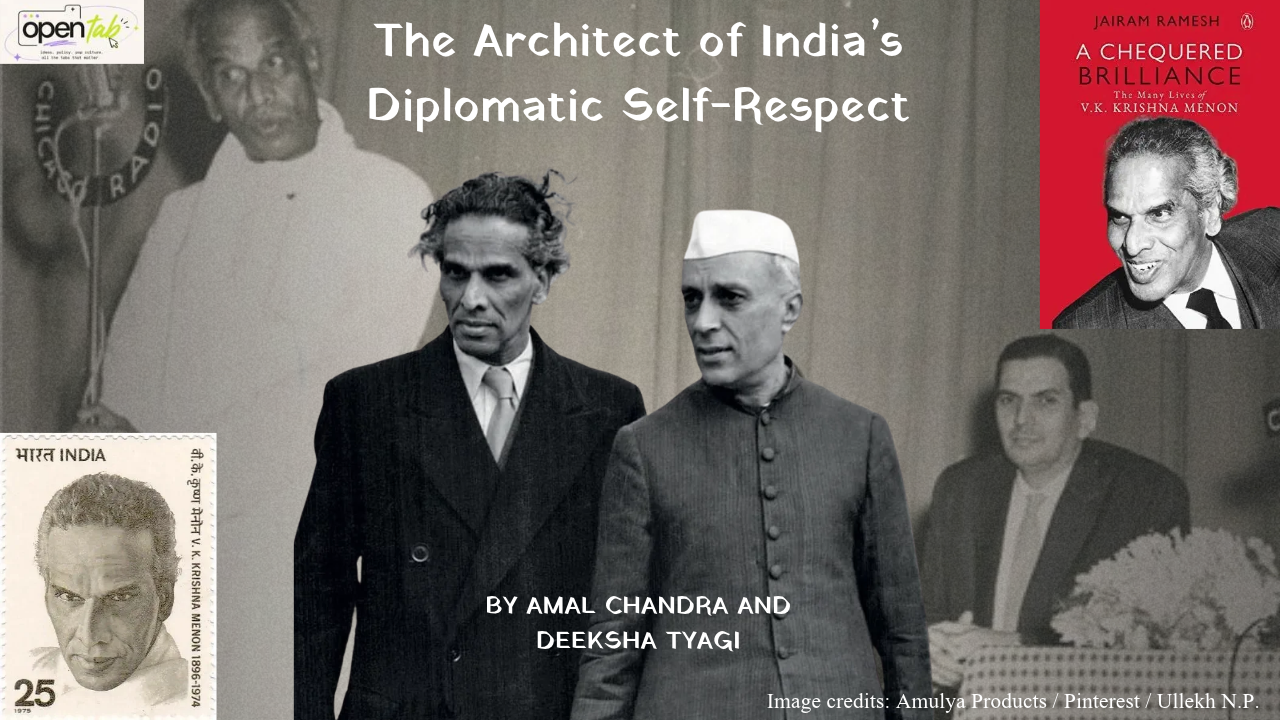
When India today speaks of strategic autonomy, a stronger voice for the Global South, reform of multilateral institutions, and the freedom to judge international questions on their merits, it uses a vocabulary with deep roots in the Republic’s early decades. Few individuals gave that vocabulary more intellectual force than V.K. Krishna Menon. He remains one of the most polarising figures in modern Indian history: admired as a formidable diplomat and anti-colonial thinker, condemned as abrasive, doctrinaire and disastrously overconfident as defence minister. Any serious assessment must hold both truths together.
That balance matters especially now. India is materially stronger than the country Menon represented in the 1950s. It is the world’s most populous country, a major economy, a nuclear-armed state, a member of the Quad and BRICS, and a country that simultaneously maintains close partnerships with the United States, Europe, Russia, West Asia and the developing world. During its 2023 G20 presidency, India successfully pushed for the African Union’s admission as a permanent member and convened the Voice of Global South process. The language is contemporary; the instinct is older.
Menon’s political formation occurred not in New Delhi but in inter-war Britain. Born on 3 May 1896 in Calicut, he went to England in 1924, studied at the London School of Economics under Harold Laski, trained in law, and immersed himself in British progressive politics. He became the driving force behind the India League, turning it into one of the most energetic organisations campaigning for Indian independence in Britain. It lobbied parliamentarians, cultivated journalists, organised meetings and challenged imperial narratives on their home ground.
That experience shaped his diplomacy. Menon understood that power operated not only through armies and treaties but through language, prestige, law, public opinion and the authority to define a problem. He learned the British establishment from inside and became unusually adept at arguing with it on its own intellectual terrain. After independence, Nehru appointed him India’s High Commissioner in London, where he served from 1947 to 1952. Their partnership would become one of the defining relationships of early Indian foreign policy.
Menon was not the sole author of non-alignment; that distinction belongs to a larger political project associated above all with Nehru and, internationally, leaders such as Josip Broz Tito, Gamal Abdel Nasser, Sukarno and Kwame Nkrumah. But Menon was among its sharpest theorists and practitioners. The Ministry of External Affairs records that he used the term “non-alignment” at the United Nations in 1953. Its meaning was often caricatured abroad as neutrality. In practice, the doctrine sought something more demanding: independence of judgement.
For a newly decolonised state, that was not rhetorical vanity. India had emerged from two centuries of imperial subordination with limited military and economic power. Joining a Cold War bloc would have traded one form of external dependence for another. Non-alignment allowed New Delhi to work with the West where interests converged, cooperate with the Soviet Union where useful, oppose colonialism, support decolonisation and preserve diplomatic room for manoeuvre. Menon gave that position an argumentative edge that sometimes bordered on provocation.
His great stage was the United Nations. There he developed a reputation for speeches that were dense, legalistic, historical and frequently exhausting. The most famous came during the Kashmir debate in January 1957. Popular memory has compressed it into a single marathon address, but UN records show that Menon’s intervention stretched across three Security Council meetings on 23 and 24 January and lasted more than eight hours in total. The performance remains the longest statement associated with the UN’s records of such speeches.
The significance was not the duration. Menon treated the Security Council as a courtroom in which India’s sovereignty, the circumstances of accession and the history of the dispute had to be argued line by line. He marshalled correspondence, resolutions and constitutional claims with extraordinary stamina. The spectacle made him a national hero to many Indians. Yet rhetoric did not settle Kashmir; nor did intellectual dominance automatically produce diplomatic consensus. That distinction is essential to understanding both his greatness and his limits.
His diplomacy was broader than Kashmir. India under Nehru tried to mediate major conflicts rather than merely comment on them. Menon was involved in diplomacy concerning Korea, Indochina and the Suez crisis, while repeatedly pressing questions of decolonisation and disarmament at the UN. His worldview linked peace to development: resources consumed by an escalating arms race were resources unavailable to societies struggling with poverty, illiteracy and disease. That argument, made in the nuclear age’s first decade, has lost little relevance.
But Menon’s anti-colonialism also generated blind spots. His anger was disproportionately directed at Western power, and critics accused him of applying a softer standard to Soviet coercion. Non-alignment was never as symmetrical in practice as its theory implied. Menon’s temperament worsened the problem. He had little patience for diplomatic cushioning and often turned disagreement into personal confrontation. The very qualities that made him effective against condescension made coalition-building harder.
The decisive test came not in a conference room but on the Himalayan frontier. Menon became defence minister in 1957 and remained central to policy until the 1962 war with China destroyed his political standing. It is now too simple to explain that defeat through the personality of one minister. Scholarship and military analysis have documented a wider chain of failure: poor intelligence assessment, weak infrastructure, inadequate equipment and preparation, confused civil-military relations, unrealistic operational assumptions and the politically approved “Forward Policy”.
Yet systemic failure does not erase ministerial responsibility. Menon presided over the defence establishment during the years in which the China threat intensified. His relations with senior officers were often poisonous; he was accused of favouring particular commanders; and the political leadership badly underestimated the possibility that China would respond with major force. In 1962, Indian troops were asked to hold exposed positions without the logistical and operational strength such a strategy required. Menon resigned amid the catastrophe, and Y.B. Chavan replaced him in November.
This is where hero worship becomes intellectually lazy. To describe Menon only as the victim of scapegoating is to ignore the responsibilities of office. To describe him only as the villain of 1962 is equally unserious. The war exposed failures extending from the Cabinet and intelligence system to Army headquarters and field command. Menon was part of that failure, not its entire explanation.
His career also warns that diplomatic eloquence is never a substitute for military preparedness, institutional candour, professional expertise, or the willingness of political leaders to revise strategic assumptions.
His larger legacy therefore lies elsewhere: in the diplomatic self-respect he helped institutionalise. Menon insisted that a poor country did not have to behave like a small country; that former colonies could challenge the assumptions of great powers; that knowledge of history and international law could amplify limited material strength; and that foreign policy should emerge from national judgement rather than alliance discipline.
There is a lesson here for contemporary India, but not the sentimental one. Strategic autonomy today cannot mean reflexive distance from the West, romantic solidarity with every developing country, or immunity from criticism. India’s interests are more complex than in Menon’s time: technology partnerships, energy security, defence cooperation, maritime stability, supply chains and access to capital all demand flexible coalitions. Autonomy without capacity becomes posturing; moral language without consistency becomes selective outrage.
What Menon offers is a more demanding standard. A country that seeks to speak for the Global South must bring solutions, not merely grievances. India’s successful advocacy of African Union membership in the G20 showed how representation can be converted into institutional change. Its diplomatic credibility will similarly depend on whether it can translate strategic autonomy into practical outcomes on debt, development finance, climate justice, technology access and reform of global governance.
Krishna Menon died on 6 October 1974. Fifty-two years later, his reputation still refuses easy settlement. He was brilliant and abrasive, principled and partisan, visionary in diplomacy and deeply implicated in one of India’s gravest strategic failures. But he understood something elemental about sovereignty: independence is incomplete if a nation cannot think for itself.
India no longer needs to prove that it has a voice. The harder task is to ensure that the voice is informed, credible, consistent, and consequential. On that test, Krishna Menon remains less a model to imitate than a standard against which Indian diplomacy can still profitably argue.
About the Authors:Amal Chandra is an author, policy analyst, and columnist, currently serving as National Affairs Editor for Open Tab as well as The Statement Fellow and Coordinator, South Asia at Students For Liberty. His debut book, The Essential, features a foreword by former Union External Affairs Minister of India, Adv. Salman Khurshid, and was launched by Dr. Shashi Tharoor, with whom he works on public affairs, alongside Adv. V.D. Satheesan, the Chief Minister of Keralam. Follow @ens_socialis.
Deeksha Tyagi is a writer, researcher, political consultant, and a Don Lavoie Fellow at Mercatus Centre, George Mason University, USA. She is also affiliated as a Research Associate with the Sri Aurobindo Centre for Advanced Research, Pondicherry. Follow @deekshatyagii
Join the Conversation