The Leak
Every riot has an origin story, and this one starts in an exam hall, not at Jantar Mantar. In May 2026, the NEET-UG paper leaked. It was not the first time. Every year since the National Testing Agency was created, some centre, some racket, some middleman has found a way to sell what should not be for sale. This time it stacked on top of the CBSE On-Screen Marking mess, and the two together did what a decade of parliamentary outrage and effigy-burning never managed. They convinced a generation that the exam hall itself could not be trusted.
That is the fact that gets buried under everything that came after. Before there was a satirical party, a hunger strike, a march on Parliament, or a resignation, there were 21 teenagers who did everything right and still could not be sure the result in front of them meant anything.
Pradeep Manich, 23, from Rajasthan's Sikar coaching hub, died by suicide days after the May 3 exam was scrapped. His family had sold land and taken on debt to fund his coaching, and this was his third attempt. Akanksha Chaturvedi, 18, from Nagpur, wrote “I do not dare to appear for a retest” before her death; her father worked as a cook and farmed a small plot back in Madhya Pradesh. Umesh Mali, 22, in Sikar left a note reading “Main is duniya se dur ja raha hun, sorry” - this was his third attempt too, and the cancelled May exam. Ritik Mishra, 21, from Lakhimpur Kheri, UP, had also given the exam for the third time. The list goes on – 21 is just a documented number of suicides.
The Satire That Stopped Being Funny
Abhijeet Dipke did not set out to lead a movement. In May 2026 he built the Cockroach Janta Party as an online joke, a mock political outfit built on the idea that the establishment treats ordinary aspirants like pests to be sprayed and forgotten. Satire needs a target that is already absurd to land, and the exam leak handed him one. Within days the joke had a following. Within weeks the following had a demand: the resignation of Union Education Minister Dharmendra Pradhan.
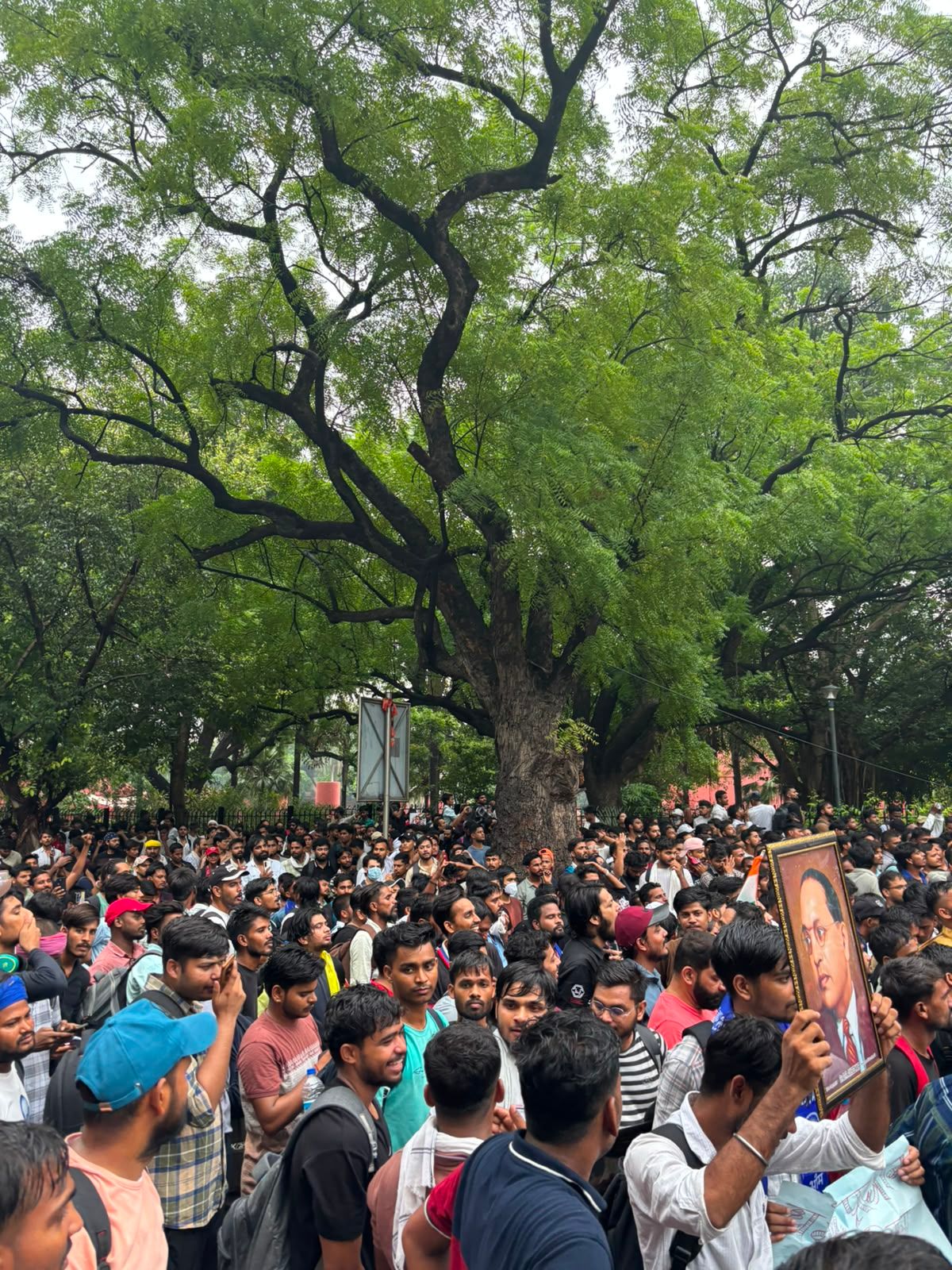
By 6 June, what began as a meme account was organising bodies at Jantar Mantar, alongside the older campus networks: the Students Federation of India (SFI), the All India Students Association (AISA) and the All India Students Federation (AISF). The satire had grown legs. It was no longer a joke about cockroaches. It was several thousand young Indians who had decided the joke was the only honest description of how they were being treated.
The Monk Joins the March
On 28 June, Sonam Wangchuk arrived at the protest site and declared an indefinite hunger strike, alongside six students from AISA. Wangchuk did not need this fight. He had Ladakh, an engineering reputation, and a life's work already built. He chose to fast anyway, and that choice is what pulled the story out of the education pages and onto the front page.
A hunger strike by a known face changes the physics of a protest. It gives television a countdown clock. It gives the government a hostage situation it did not create but now must manage. It gives critics, fairly or not, a single visible target to interrogate instead of the diffuse and leaderless CJP.
20 July: Batons and Tear Gas
The protest's defining, and ugliest, day arrived when demonstrators marched toward Parliament. Delhi Police met them with baton charges and tear gas, and protesters alleged pellet guns were used to break up the crowd. Students were injured. Police vehicles and equipment were damaged in the chaos that followed. Both sides have a version of that afternoon, and neither version is clean: a march that went further than its permission allowed, met by a police response that went further than restraint required. What is not in dispute is that 20 July hardened the standoff. Before that day, this was a protest the government could wait out. After, waiting it out meant owning the image of a baton coming down on a teenager who wanted a fair exam.
The Long No
For weeks the government held the line in public: no resignation, no negotiation on that specific demand, and a quiet insistence that a scandal in one testing agency did not warrant the head of a Cabinet minister. That posture survived the hunger strike. It survived the Parliament march. What it did not survive was the geography of the anger, which stopped being a Jantar Mantar problem and started being a national one, with sympathy demonstrations lighting up campuses far from Delhi. A government can absorb a sit-in at one traffic circle in the capital for a long time. It has a much harder time absorbing the same sit-in replicated in twenty cities, each with its own local press cycle and its own chance to embarrass a state unit of the ruling party.
25 July: The Resignation
On 25 July, Dharmendra Pradhan submitted his resignation to the Prime Minister. In his letter he wrote that he held deep respect for the aspirations of the country's youth, and that he did not want any student's future to be entangled in legal complications or exploited by what he called anti-national forces. Hours later, CJP spokesperson Ashutosh Ranka announced the movement was standing down, telling protesters that every demand had been accepted and it was time to go home peacefully.
Dipke's own reaction was two words, blunt as a headline: “We have done it. Dharmendra Pradhan has resigned.” At Jantar Mantar, a young protester was photographed walking through the celebrating crowd holding a copy of the Constitution, telling a reporter this was a win for it, and that this was not a lazy generation.
Al Jazeera's read on it, from just three days before the resignation, is the sharpest explanation:
The Gen Z-led protests, which left more than 100 people severely wounded in police baton and tear gas attacks, represented the biggest public challenge to Modi's rule so far in his third term. And the reason it counts as historic isn't just scale, it's precedent.
Modi has spent 12 years repeatedly defying calls for ministers to resign despite major controversies around them – the piece specifically points to cases like the 2021 Lakhimpur Kheri killings, where a junior minister's son was accused of running over protesting farmers and no resignation followed.
Whatever else is true about the forty-nine days between the first tent going up at Jantar Mantar on 6 June and the resignation letter going out on 25 July, that image is the one that will outlast the conspiracy theories. Not Dipke. Not Wangchuk. A copy of the Constitution held up by a kid who wanted the system to keep its own rules.
The historic part isn't the exam leak or the hunger strike. It's that a street protest actually moved a Modi government to give up a Cabinet minister – something that hasn't happened once in 12 years of scandals, farmer deaths, and opposition demands.
The Man Who Replaces Him
The same day Pradhan resigned, the education portfolio went to Pralhad Joshi, added to the ministries he already held. Five-term MP, ex-RSS worker, and a man who has already fought this exact fight once before: when Karnataka revised its SSLC textbooks and critics called it saffronisation, Joshi did not hedge, he dismissed them as people who couldn't tolerate the BJP's ideology.
Worth noting, not worth dwelling on. The kids at Jantar Mantar won the fight they came for. What happens to a Class 10 history book next year is a different chapter.
About the Author: Raju is the author of ‘Mera Paas Maa Hai’. He was formed in Mehdipatnam , uneducated at Hyderabad Public School and battle-tested at Osmania University through an Engineering degree and an MBA. He then spent 35 years being a useful troublemaker at companies like Mieroland, IBM and Deloitte. These days he cycles, roams the world and sings Kishore songs badly.
Join the Conversation