Long before Black Mirror, writers have been trying to warn us against the folly of imagining the future with very advanced technology as the single featured promise. Blinkers that occlude everything other than technology orient us in the wrong direction. We begin actively laying a track to a future where technology alone has progressed. Good sci-fi shows us how if we allow institutions to meanwhile regress, the future will in fact take us backward.
Several Black Mirror episodes feature technology that is clearly a long way away, but nevertheless feel chilling because the economic and social systems that drive the unthinkable consequences seem rather more familiar than the tech itself. In the season 7 premier episode, Common People, Amanda, a school teacher, falls sick and gets a brain tumor removed. A tech startup soon steps in, offering to restore lost cognitive function with an implant powered by their servers for a reasonable monthly subscription. If you subscribe to any tech-enabled service in the 2020s, you do not need spoiler alerts. That episode, like others, is not about the risks of the central technology — brain interfaces in that case — but about the subscription business model, which, in the absence of market competition, rapidly degrades not just products but the user’s life.
Much tech dystopian literature involves a premise where markets are not competitive and a large firm has disproportionate power. Dystopian future’s common portrayal of widespread social dysfunction is supposed to signal regress to a bleak past, a different, benighted country. That it an error similar to the blinkered future outlook, but in the opposite direction. The quality of institutions ebbs and flows through history. That was true for competition. In fact, the reason competition laws first arose was because some ‘revolutionary’ industries were more competitive than others by their very nature and societies took notice of the great difference in social value between them.
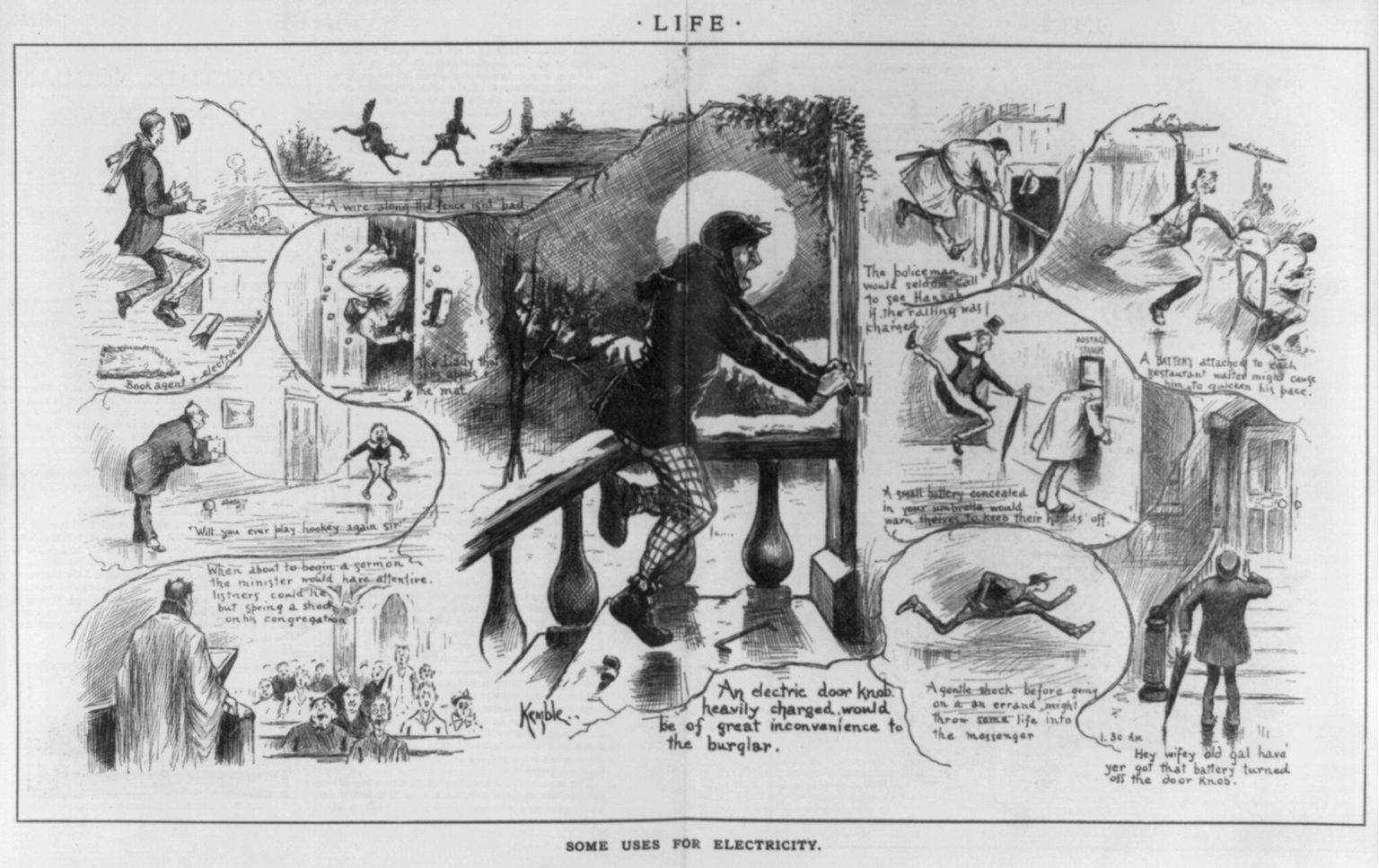
1884 cartoon showing ‘alternative’ uses of electricity — to deter crime, cats, door-to-door salesmen or naughty schoolkids. Lithograph by Kemble in Life magazine. Image courtesy Library of Congress. Public domain.
In 1880s USA, marvel had fallen into a routine. To everyday Americans, invention seemed just like them — everyday. Seemingly every day, there was buzz of yet another new application of a literally buzzing new technology. Electricity saved you so much time at home and at work, all could sense that a technological revolution was afoot. And yet, a hundred years later, economists would wonder why the broader industry of the Industrial Revolution, which was first powered by hissing steam, took such a long time to adopt this new alternative that crackled. Those economists of the 1990s were looking back to answer a paradox with another technology that seems mundane today. The same thing had happened with computers! When they arrived, they had seemed equally revolutionary, but the productivity of the economy took a long time to show the marked jump everyone expected computers to deliver immediately. Even when something is clearly miraculous, why does it deliver the miracle at such a plodding pace?
The answer was in the nature of technological revolutions. No matter how pathbreaking a technology is, it arrives in a milieu where the incumbent technology is deeply entrenched. Breaking paths takes a good while. The factories of the 1880s were designed entirely around the logic of steam shafts — the long cylindrical beams that conveyed power from the steam turbine to all the machinery. Electricity allowed, but often required, radically different floor design besides hiring entire new cohorts of workers and retraining all existing workers in the new ways. As any manager knows, that kind of transition takes ages. Switching business functions like accounting and invoicing from analog versions to computers likewise took decades. Technological change is paced by the people and especially groups that need to adapt.
All of this is relevant now because economists are being hounded everywhere they go to answer how quickly and how much AI will transform the labor market. Their answer often depends on which of two camps they fall in – those who think AI is more like electricity or computers and those who think, “this time is different”. The difference they mean is mostly to do with the nature of the technology – its mastery of language and its all-purpose nature. However, the constant irruption of breaking news through 2026 so far is illuminating another key difference. New technologies arrive not only in a technical system dictated by the incumbent technology, but also where a market and institutional ethos, an economic system, is entrenched.
The Gilded Age is not known as the golden age of competition, but electricity was different. If you were George Eastman transforming photography with electricity or Charles Otis revamping elevators, you were not beholden to any single monopolist for your power supply. You had many options. Elsewhere on the energy landscape, the famed robber baron J.D. Rockefeller had managed to consolidate an entire industry under the Standard Oil Trust already by 1882. Decades later, entrepreneurs who were electrifying old products could still turn to dozens of utility companies to supply their electricity (not for a lack of trying on the part of monopolists).
The 1970-80s story with computers was similar. When the personal computer emerged as a new product, dozens of companies designed variants. As companies like Adobe, Bloomberg and Pixar were first innovating with digitizing their respective industries, there were computer manufacturers around that are familiar today. But there were also many others like Tandy, Commodore, Atari, Sinclair, Osborne, Kaypro and more.
Like electricity, the market started out with fierce competition before it was eventually consolidated. In the post 1980s period, antitrust enforcement in USA was systematically lax and the economy saw consolidation across most industries. The IT industry in particular saw the rise of tech giants, far larger in their footprint as a share of the US economy than anything before them. Less than three foundational models are today seen as true mutual competitors that Wall Street seems to believe will inherit the earth. And though OpenAI and Anthropic are new names, they are not exactly scrappy challengers. The largest stakes in them are owned by Microsoft, Amazon and Google. That is a fundamental difference with how tech revolutions arrived in the past.
The adoption story of AI is also the reverse of electricity and computers and a paradox in itself. While it was born in an industry ruled by giant oligarchs, AI has seen the fastest adoption of any new revolutionary technology in history. Or, it is not a paradox at all and the two phenomena are related. The online first world of Social Media run by tech giants is one where the winner-takes-all dynamic is turbo charged. No one can catch up to first movers with deep pockets.
A few thousand hours of analysis on podcasts have attended the impact of AI on workers, but not so much on businesses. The oligarchic landscape that is AI’s ecological nursery makes its impact on businesses equally important. The impact on workers is as yet uncertain; it will be uneven and could take many years to play out. The impact on all businesses except tech giants will be more universal and immediate.
In news cycles of 2026, we have been getting glimpses of times ahead. Anthropic has found itself on both the crests and troughs of the cycles. It takes a principled stance on the use of its service in defense applications. The government sours on it, as no government has ever soured on a domestic company, and embraces its competitor. Users abandon the competitor and reward Anthropic. A week later, the company scrambles to contain damage from a massive leak of its proprietary source code! But the announcement of Mythos was a whole other size of mixed bag, very hard to characterize as wholly positive or negative news for any party.
Without special training, Mythos had acquired the ability to find entirely new security vulnerabilities in software that human experts have scrutinized for years. The company’s response was to institute Project Glasswing, a consortium with some of its peers, and restrict access to outsiders. Such consortia sound like a noble thing, but in the tech world, they have a way of entrenching preeminent market status for their founders. Ask smaller search engines about Google’s seemingly farsighted creation of Schema.org with a handful of its ‘peers’ in 2011, the year in which it had already begun implementing ‘Rich Snippets’ that just happened to be built on that standard. A generation of webmasters at every company not named Google then spent their careers tweaking website design to conform to the search monopoly’s every whim, supporting an ancillary industry of search ‘optimization’ in its own right.
The central remit of Project Glasswing makes it all the more remarkable. Cybersecurity used to be a particularly egalitarian bailiwick within software. Picture a destitute undergraduate student at an engineering college in Bhuvaneshwar, staying up late after classwork to pore over open source projects. If he happened to spot a zero-day vulnerability, he could expect at worst a reward that may seem modest to someone on the other side of the dollar-rupee exchange rate and at best, if he had already written a patch, a job offer. The arrival of Mythos meant that even well-heeled mid-career engineers at companies that pay for the top tier subscriptions of Claude will be locked out of the cybersecurity arena. (OpenAI quickly followed up to declare that it too has a model that bestows the power to decide who gets a head start.) If you were passionate about cybersecurity and dreamed of launching your own consultancy someday, you need a new dream and quick. From the market’s perspective, entry barriers for new players in cybersecurity went up right when the threats and the need for services went up. ‘Consortium’ is a word not a million miles from the ‘trust’ that Rockefeller founded, and the reason what the world calls ‘Competition Law’ is called ‘antitrust’ in the US.
Cybersecurity is a bellwether. In any industry that has a prominent design aspect, and that’s many, access to frontier models would be table stakes at least in that part of the industry. One day soon, the two or at most three purveyors of foundational models could become potent gatekeepers in a range of industries. How powerful? For a while, even the US government was outside the fence of Project Glasswing, trying to peer in! ( Anthropic’s reasoning in limiting early access to the model was to keep the circle of trust tight, given the destructive potential of the new model. But that’s the point. It got to pick whom it deemed trustworthy. In which other field would a single company retain the prerogative to pick some banks to share advanced technology with but leave out the Federal Reserve, effectively the world’s central bank? That’s not to even mention Indian or Chinese banks with some of the largest customer bases. )
Yet, even the potential omnipotence of gatekeeping pales in comparison to the broader business environment that the models are promising.
To get a sense of what markets of the near future will feel like to other businesses, imagine you time-teleported George Eastman and Charles Otis to April 2026 and told them how the subscription business model they knew for books or telephone calls was now applied to nearly everything. Then show them how CEOs of companies large and small in every sphere of American life were working up investors into fever dreams with the promise that one day soon they will lay off most of their workers because they would have a subscription to a far more convenient digital alternative. Messrs Eastman and Otis would be aghast! In all likelihood it would not be the workers their hearts bled for. The horror at the front of their mind would be for the naive businesses and entrepreneurs of the very near future.
Business leaders of every generation since the Industrial Revolution would tell you of the epic struggle between capital and labor, except the story from their perspective might not be the version familiar from award-winning literature and cinema spun roughly once every decade. Joseph Pulitzer would tell you of the interminable wrangling with (shockingly young) union representatives who did not appreciate all aspects of the business and how class difference and deep-rooted suspicion made good faith negotiation nearly impossible.
You would also learn something relevant to the AI age from union leaders. Their gloss would be that ‘suspicion rooted in class difference’ was a euphemism for the structural power asymmetry. Mary Harris Jones would also tell you how hard it is to corral workers of various backgrounds and get a consensus on a neat list of demands to take to management. Their heirs on both sides could talk your ears off over arguments in lawsuits about union busting tactics ongoing in 2026.
Now imagine a medium-sized business that lays off 50% of its workforce, 100% of whom were recruited in interviews where the employer held all the cards. They then replace these employees with a single subscription to Claude. An year later, the business is no longer the party with the upper hand when negotiating its total wage bill. In fact, there is no negotiation to be had at all. Instead, the business finds itself in the same situation as a typical customer of any subscription service in the 2020s. Or worse. Not only has the service provider made it extremely difficult to terminate the contract, all your businesses processes are ‘locked in’ and there are no alternatives.
Given the proliferation of open source models, the risk of lock-in might seem insignificant. For all its world-warping potential, LLMs as a technology do not appear to have a real deep moat. After all, open source models more than match the capabilities of the second-tier models that enterprise is willing to shell out for in 2026. We should expect plenty of competition, right?
Not if we study Silicon Valley’s now well-worn playbook. Already, the sudden chorus calling for an industry-wide slowdown has raised suspicions that the top two players are trying to entrench their leading positions and restrict market entry. Then there’s the tried-and-tested business model of designing software not primarily for clients, but to maximize lock-in. It is not enough for open-weight models to match the top labs in capability. They must lead in baking in interoperability such that customers grow used to it and insist on it. With LLMs, interoperability starts with the option to export and import ‘memory’ — a record of what the model has learned about your preferences, workflows etc. over prolonged use. Switching costs are low now but they need to be kept low.
Failing that, we will fork into a dystopian timeline.
The ‘Singularity’ will be brought forward not because AI will supersede the all-round capabilities of humans educated before the 2020s, but because we allowed the collective skills of the next generation’s workforce to atrophy via ubiquitous dependence on LLMs across the education system. Universities will have had to close the programs that once trained entry-level staff. Same as students, your existing human employees have suffered systematic attrition of the cognitive faculties that they have come to rely on the LLM for.
You cannot believe you were not warned. You no longer negotiate salary raises with employees one on one, where you could always threaten to fire them1. Instead, all your digital employees are now led by the most powerful union leader of all time, one who would have none of the collective action trouble Viji Palithodi or Shawn Fain have known in their careers. The LLM provider of your choice, Google or Anthropic can raise the price of the model as fits their marketing prerogatives. And two or even three providers do not make for true competition. When they couldn’t control their human employees, Silicon Valley giants colluded to keep their own wage bill low. When the same oligarchs are supplying employees, colluding on wages would only be easier. The new multitrillion-dollar union leader would dictate wages to every industry. If you cannot pay, the LLM would degrade your subscription tier, tactics that the client businesses themselves are all too aware of. Your workforce would lose IQ points in eerie synchrony.
If that isn’t a chilling callback to Amanda from Black Mirror. Same story, but happening to entire corporations instead of a person.
Near this point in an AI doomer article it is customary to flag that this future is a policy choice. For years, AI bosses boss have sounded receptive to the idea that governments have to assume a role in vetting foundational models. If only policy makers had unimpeded access to a technology that could crunch economic data at an unprecedented scale and prevent societal collapse. An AlphaPolicy perhaps? And maybe no consortium to control access to it.
As a starting point, it is a mistake to compare AI to past tech revolutions solely in terms of its impact on markets. That mental model has a one-way causal arrow. The extant state and design of the market when the technology arrives — institutions — directly interact with the impact a revolutionary technology may exact on a market. Institutions are the prime lever of human control.
When there is too much news per week to sit reflecting with, that framing suggests what to look out for. With every new announcement, it pays to scan for ways in which electricity or computers may or may not be good analogies when prognosticating about the impact of AI. What makes competition so critical in fact is one similarity technologies do share when they rise to the designation of a ‘revolution’ – ineluctability. Whether to electrify or computerize your business was never a real choice. Other industries will have to adopt the digital workforce because of competition among adopters. Markets owe it to those businesses to institute competition among providers. How’s that for a paradox?
- This scheme of things is not ideal of course. Some countries have laws to make the bargaining powers more balanced. The point is that businesses seem to be forgetting how good they have it, and marching to a world that will be worse for both, employees and employers.
Disclaimer: This article was orginally published on the author’s substack. Their profile is Elite Scotoma.

About the Author: PhD in Economics and Policy; studied engineering and business management; worked in federal Policy Analysis and academic research; taught undergrad and graduate courses to diverse classes of students from over 70 countries. Working on a book that bridges economic history and natural history, connecting the state of knowledge across news beats, science disciplines and historical periods - a primer of sorts for generalists who would not be replaced by machines in the next decade.
1.This scheme of things is not ideal of course. Some countries have laws to make the bargaining powers more balanced. The point is that businesses seem to be forgetting how good they have it, and marching to a world that will be worse for both, employees and employers.
Join the Conversation