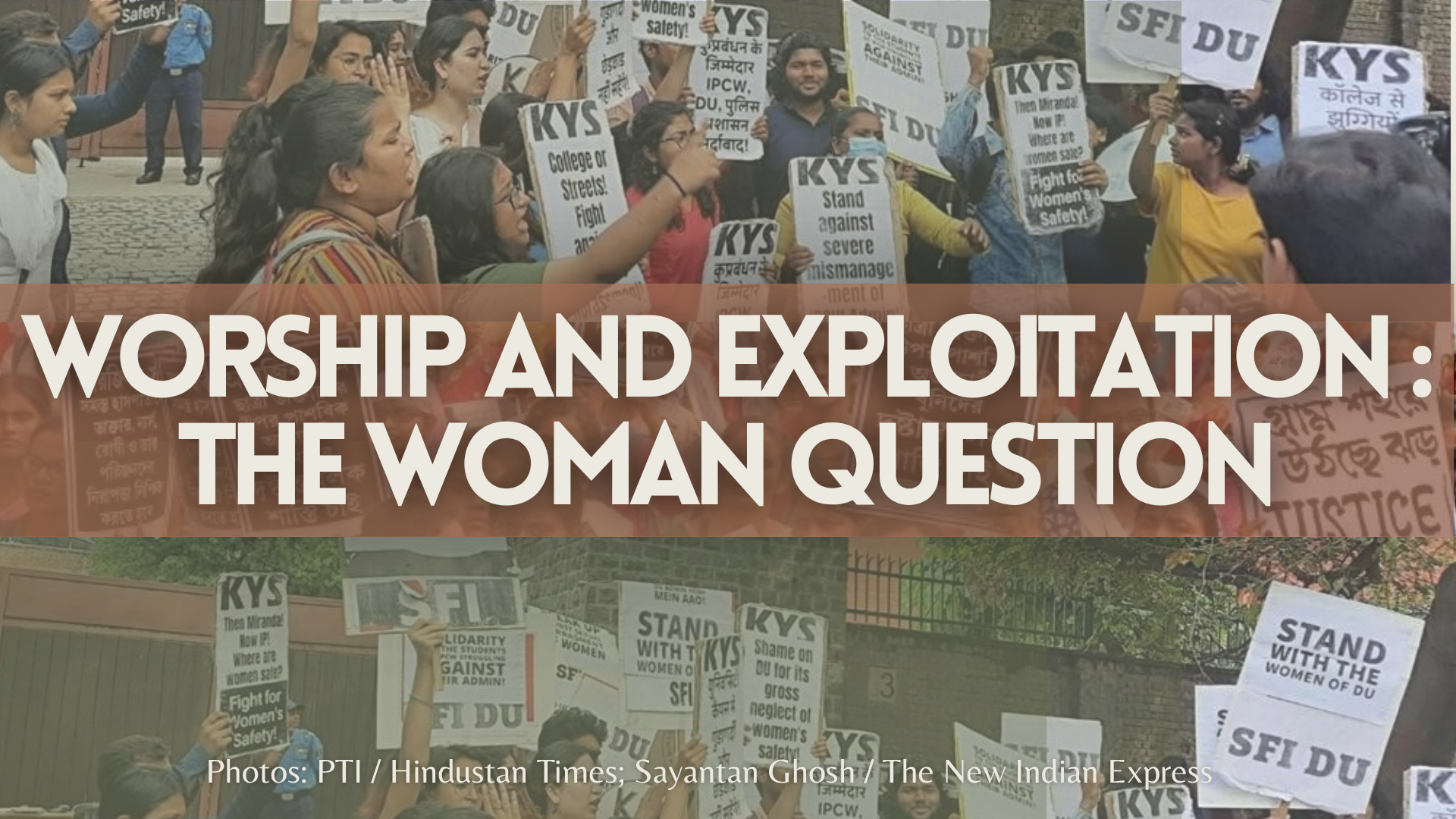
The country has once again been forced to confront its systemic failure to protect women, from the gang rape of a 16-year-old girl inside a moving sleeper bus to the recent cases reported near Lady Shri Ram College and in Jamui. Two years after the brutal rape and murder of a postgraduate resident physician at R.G. Kar Medical College, the question of women’s safety in our country still awaits an answer that can offer real solace to victims. Sending the culprits to the gallows is the prevailing call for justice, but how far this actually solves the systemic problem remains a matter of debate.
However, beyond the vital demands for strict punishment and accountability we must examine the deeper issues at play. These include a pervasive rape culture and a deeply entrenched patriarchal mindset that continues to police women’s bodies, dignity and honor. True justice demands that we address the violation of human dignity, the breach of consent, and the judgemental gaze of a society engaged in character assassination. These require a more nuanced understanding.
First, consider the act of rape itself. Feminist theorists like Catharine MacKinnon in her work “Towards a Feminist Theory of the State” argue that it is fundamentally an act of power, control and domination. Rather than a crime of mere opportunity, it is weaponized to enforce patriarchal authority and instill fear, punishing women for simply using or occupying public spaces. This brutal assertion of power thrives even beneath the glossy veneer of our metropolitan cities and despite the existence of stringent laws. If we look carefully at recent tragedies and the countless other cases, it becomes glaringly evident that presence of laws by itself is not enough to deter violence when the underlying cultural mindset still sanctions the subjugation of women.
This same power dynamic becomes core even while considering the question of human dignity and the breach of consent. In cases of gang rape, this violation is exacerbated by the "diffusion of responsibility" inherent in group behavior, wherein the group feels less guilty of the crime because more people were involved. However, this dangerous precedent does not exist in vacuum. It is almost routine to witness a glaring power gap between men and women in everyday social setups, whether at home, at the workplace, or elsewhere. The exploiter is typically the one in control, revealing that sexual violence is not primarily a crime of sexual gratification, but rather a crime of violent, extreme extension of everyday gender inequalities normalized by patriarchal society.
This dynamic of dominance is starkly visible within the professional sphere. In the year 2023, The News Minute cited data revealing a 40.4% increase in sexual harassment complaints across major Indian companies, reflecting both deeply ingrained corporate issues. In the entertainment industry in the year 2024, the Justice Hema Committee Report has served as an electrifying wake-up call, documenting years of systemic sexual harassment and unequal treatment entrenched within the Malayalam film industry and serving as a warning to creative industries everywhere.
While the Prevention of Sexual Harassment (PoSH) Act, 2013 as designed to address these environments, significant implementation gaps remain. A decade after its inception, ambiguities persist regarding the coverage of students, the status of film sets as workplaces, same-sex harassment, and cross-examination rights. Furthermore, the law fundamentally fails marginalized workers; despite its progressive intent, it offers little protection for women in the informal sector, particularly those from Dalit, Bahujan, and Adivasi communities. Although, the PoSH Act is often criticized for lacking gender neutrality leaving men, trans individuals, and queer people vulnerable but, various legal and feminist scholars caution against a blanket gender neutral approach. In India's deeply patriarchal context, a strictly gender-neutral law risks being weaponized against women through retaliatory cross-complaints, illustrating why the legislation maintains an asymmetric, women-centric framework.
Next, we must address how society blames the victim through character shaming. Melvin Lerner’s "Just World Hypothesis" highlights a cognitive bias emerges of human desperation to believe that good things happen to good people and bad things happen to bad people. This bias is coupled with "Ambivalent Sexism," which operates on two extremes. Benevolent side views women as pure and morally superior but inherently in need of male protection, justifying their confinement within the four walls of domesticity. Hostile sexism, on the other hand, aggressively punishes those who reject traditional roles, manifesting in harassment and character assassination.
This dynamic is further sustained by the "Patriarchal Bargain." According to this concept, some women in order to survive and get small measure of security or status make a bargain to conform perfectly to patriarchal rules. As a result, they may aggressively shame women who rebel, because those who break the rules threaten the fragile security and societal approval the conforming women have worked so hard to achieve.
It is crucial to understand that this crisis is too grave to be ignored and too urgent to be delayed. Statistics tell a horrifying part of the story. The NCRB's latest annual data (2024) recorded 29,536 reported rape cases across India. Based on the same dataset’s historical data averages, a woman reports a rape approximately every 15 to 20 minutes in this country. Sexual violence, which affects one in every 16 women in India, most commonly first occurs during adolescence. Yet this is fraction of reality, the number unreported cases remain dauntingly high, pervasive social stigma, fear of retaliation, and an intimidating legal process mean the vast majority of sexual assaults are not recorded in complaints. To make matters worse, in roughly 89% to 95% of reported cases, the accused is a relative, neighbor, friend, acquaintance, or partner (NCRB). Meanwhile, conviction rates hover dismally around 27% to 28% as reported by The Economics times in the year 2020. In fact, over 90% of rape cases remain pending trial at the end of any given calendar year.
As a society, we celebrate our women, be it the laurels of our female athletes, women in the armed forces, or those building business empires. Culturally, we worship the female form as avatars of goddesses. Since time immemorial, our country has proudly housed some of the greatest women the world has seen, from Gargi, Pandita Ramabai, Savitribai Phule to Dr. Muthulakshmi Reddy, Sarojini Naidu among many others. Some fought with fury; some showed us patience and others touched our hearts with kindness. But these are some exceptions, for an average women daily life is not defined by pedestals, rather by quiet battles of basic bodily autonomy. As a society we must build a nation where the common girl feels appreciated, supported, and above all, respected. Only then we can truly redeem the words Maya Angelou gave us:
Leaving behind nights of terror and fear
I rise
Into a daybreak that’s wondrously clear
I rise
Bringing the gifts that my ancestors gave,
I am the dream and the hope of the slave.
I rise
I rise
I rise.
About the Author: In her own words “Not a typical writer, just trying to make sense of the world and put life, culture and our collective madness into perspective. Also, managed to clear UPSC-CSE 2025-26, but we don’t make that my whole personality here.”
Join the Conversation